There's water in your apartment. Not from your sink. Not from your toilet, or your neighbor's toilet (thank god). From outside. Through the wall. Through the door frame. Dripping onto and INTO your hardwood floor. The board's plan? A $30 can of paint.
Here's how this usually plays out
It started in October. A small dark patch above the sliding door. You sent a polite email to the property manager and got back "Noted, thanks!" with a thumbs-up emoji. You felt heard.
November. The patch had grown. Another email. This one got "We'll have someone take a look."
December: nothing.
January: the patch was now a brown ring with a soft middle. You could push your finger into the drywall. So you escalated. You walked down to the building manager's office. The building manager said "You know what, let me get our maintenance guy up there."
The maintenance guy showed up a week later. He carried one bucket, one roller, and one half-empty can of off-white paint. He spent twelve minutes in your apartment. When he left, the ceiling looked great.
When it rained the next weekend, water came in through the same spot.
If any of that sounds familiar, you're not imagining the pattern. There's a real legal name for what the board just did. There are also real things you can do about it.
First: this is almost certainly a condo, not an HOA
Quick clarification before anything else. If you're in an apartment-style building with neighbors above and below, you're almost certainly in a condo association governed by the Illinois Condominium Property Act (765 ILCS 605). HOAs typically run detached homes and townhouse communities under the Common Interest Community Association Act (765 ILCS 160). The duties overlap. The statutes don't. We're going to stick with condo for the rest of this.
Your stuff. Their building.
Inside your unit is yours. Drywall, finishes, fixtures, flooring. Outside that interior shell starts the common elements: the exterior wall assembly, the door and window frames that sit in it, the structural framing behind it, and the roof. The board owns those. All of them. Under 765 ILCS 605/18.4, the statute imposes a duty to maintain them. Not a request. Not a "we'll look into it once we have the reserves." A duty.
Here's the quick test, when in doubt. Can the homeowner paint it without touching a structural beam? If yes, it's the homeowner's. Anything else is the building's. And the building belongs to the board.
How water actually finds you
Rain is supposed to glide off the roof and into drainage. Sometimes it doesn't. Fissures (a fancy French word for holes, tears, cracks) open up, flashing fails, gutters back up, and the water has to go somewhere. Once it's inside the wall cavity, water doesn't care about unit boundaries. It can travel sideways for fifteen feet, drop down two floors, and pop out in someone's bedroom. It bypasses your neighbors, because they're lucky and you're not. And somehow it finds you.
Because gravity routed it through whatever opening the building gave it, and your unit is where the path ended.
Fiduciary duty, in English
Boards in Illinois carry a fiduciary duty to the owners they represent. In plain language: they took a job. The job is running the building like adults. That includes keeping it sealed against the weather.
A roof that leaks. A frame that drinks rainwater. An elevator making sounds elevators shouldn't make. Those are board problems before they ever become owner problems. The same fiduciary duty that prevents the treasurer from using association funds for a Caribbean cruise also requires the board to spend those funds on the things the building actually needs. Like, for instance, the roof that's letting water into your apartment.
A real fix vs a coat of paint
Every problem has a real fix and a cheap dodge. The real fix addresses the source. The dodge covers the symptom. Painting over water damage without finding the leak is the textbook dodge. If your board offers a dodge, "cheaper" cannot be the reason. That's not a justification. It's an admission.
Here's the part most boards don't think about. Every can of paint they buy is another exhibit. They knew the defect was there. They had it on file. They sent a guy with a roller and called it maintenance. That's the fact pattern that turns a routine maintenance complaint into a negligence claim under 765 ILCS 605/9.1, the statute that lets owners recover for interior damage caused by the board's failure to maintain common elements.
If your case ever ends up in front of a small claims hearing officer or a judge, the paint job is the strongest piece of evidence in the room. And it's the board's own employee who handed it to you.
What to actually do
Put it in writing. Send the board a formal request describing the water intrusion, the crack, the interior damage, and the date someone painted over it. Email works. Certified mail is better. Include dates, photos, specifics.
How to
Put the water damage on the board in writing
A dated, specific written notice is what turns "we'll look into it" into a duty with a clock on it. Copy this, fill in the brackets, and send it where you can prove it arrived.
Subject: Water intrusion and common-element repair - [name], [unit]

To the Board of Directors:

Water is entering my unit at [address] through [the sliding door frame / exterior wall], which is a common element. The damage so far: [brief description]. On [date], maintenance painted over it without repairing the source.

Under 765 ILCS 605/18.4, the association has a duty to maintain the common elements. I request a written repair plan and a date within [14] days.

Sent [date].
[Name] / [phone, email]
Naming the common element, the statute, and a date turns a complaint the board can wave off into formal notice it has to answer.
That letter is step one.
You can send the above letter, or we can handle the whole case ourselves, from start to finish.
Get my free assessmentNo payment now. The $349 only starts your case if you act.
Boards drag their feet on written notice for one reason: most owners give up. They send one letter, get no response, and assume the system doesn't work. The system works fine. You're just not done.
Written notice creates a paper trail, puts the board on formal notice, and starts a clock.
If they ignore it, escalation is available:
- Request agenda time at the next board meeting and raise it on the record
- File a complaint with the IDFPR (Illinois Department of Financial and Professional Regulation) if a licensed property manager is involved
- Pursue interior damages under 765 ILCS 605/9.1 if the unrepaired common element caused them
- Talk to an Illinois condo attorney about a civil claim before the damage gets worse
Keep every estimate, every receipt, every email. If you end up paying out of pocket to fix damage the unrepaired common element caused, those costs are recoverable. The board's failure doesn't shift the bill to you.
The math nobody at the board meeting wants to do
Water damage isn't a fringe building issue. It's the second most common home insurance claim in the country (just behind wind and hail), hitting about 1 in 67 insured homes every year. The average payout is over $15,000, and the industry-wide bill runs around $13 billion a year. Insurance Information Institute and NAIC numbers.
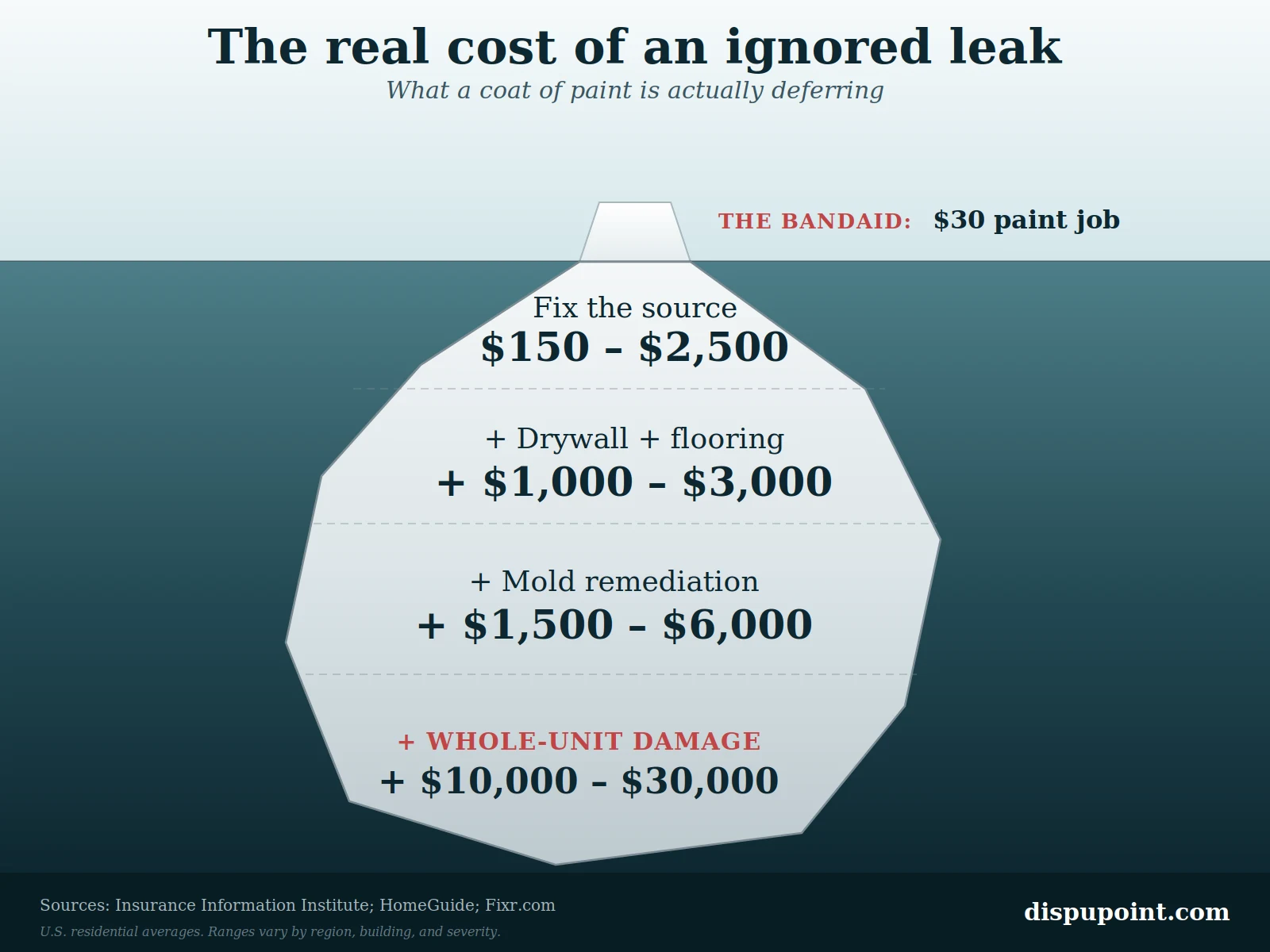
And the longer the leak runs, the more it costs. Fix it now and you're somewhere between $150 and $2,500. Wait through the seasons and drywall and flooring stack on. Wait longer and you're paying for mold remediation. Wait long enough and a whole-unit remediation can run $10,000 to $30,000. The bill doesn't shrink while the leak runs. It compounds.
Here's the bitter joke. The same board that won't approve $2,500 to actually fix the door frame will, two years from now, write a $30,000 check for the mold remediation, the drywall replacement, and the new hardwood. They will frame it as a tragedy and a fluke. It was neither. It was the bill they ran up by not paying the first one.
The board's job is to keep the building sealed. The cheapest version of that job is the one done first. Every month a coat of paint stays on the wall, the bill grows. Someone is going to pay it. Make sure it's the entity that actually owed the repair in the first place.
Where DispuPoint comes in
You don't need a lawyer on retainer to push a board into doing its job. You need a structured read of the facts, the specific statutory grounds the board is on the wrong side of, and a letter the association will actually answer instead of forwarding to property management.
That's what we do. $349 flat, Illinois only. We read your documents, identify the statutes that actually apply, and draft the demand letter you sign and send. Every case is reviewed personally before it reaches you.
If your unit is taking water and the board's plan is a paint can, start your case. We'll tell you what you have and what to send.
FAQ
How do I know if my sliding door frame is a common element?
Almost always, yes. In Illinois condo declarations, the building envelope and anything that sits in it (door frames, window frames, balconies, exterior wall assemblies) is defined as a common element. The association has to give you a copy of the declaration on request. Read it once, mark the section, and you'll have your answer in writing.
What if the board says it's my responsibility?
That's the most common deflection in the playbook. The declaration is the tiebreaker, not the manager's opinion. If the component is listed in the common elements section, it's the board's responsibility no matter what someone tells you over the phone. Get their position in writing from the board itself. If they put a "your responsibility" claim in writing while the declaration says otherwise, you now have both the leak AND a written admission of bad faith. That's a useful day.
What if they just ignore the whole thing?
Silence isn't a defense. It's a confession. Get on the agenda at the next board meeting and make them refuse you on the record. File with IDFPR if a licensed property manager is involved. Pursue interior damages under 765 ILCS 605/9.1 if the unfixed common element caused them. Most owners stop after one ignored email. The system works fine. It just needs someone who keeps going.
Can I withhold my assessments until they fix it?
Don't. Illinois law doesn't give owners that right, and doing it lights up the board's lien process without doing anything about your repair. Late fees, collection action, and a lien on your unit are not leverage. They're the board's leverage on you. Keep the assessment current. Push the repair through the proper channels. Merging the two only weakens your position.
What if they say the crack is pre-existing?
Age doesn't eliminate the duty to repair. The question is whether the component is a common element, not whether the damage is new. If water is entering your unit through a common element today, the association is responsible for stopping it today. "It's always been like that" isn't a defense. It's a confession that they've known about it for a while.
How do I put the water damage on the board in writing?
A dated, specific written notice is what turns "we'll look into it" into a duty with a clock on it. Copy this, fill in the brackets, and send it where you can prove it arrived.