A client came to me last month. Specific problem. He owned a townhome in Cook County, and almost every other owner in his small association had stopped paying the part of HOA dues that covered trash collection. Period. Not most of them. Almost all of them.
He wanted to know his options. The first thing I asked him wasn't a legal question.
Have you actually talked to them?
That was the first question. Have you reached out to the other homeowners directly? Not a board notice. Not a violation letter. A phone call. In all honesty, that's the human thing to do. We never know what's going on with someone until we actually call them and listen.
Here's what made this case more interesting. The majority of the units were owned by absentee landlords. Some properties were for sale. So when the board was sending notices, those notices were going to addresses where nobody was reading them. The non-payment wasn't refusal. It was something else entirely. A logistics problem dressed up to look like refusal. That distinction matters before anyone reaches for a lien.
Before you pick up the phone, check the mechanics
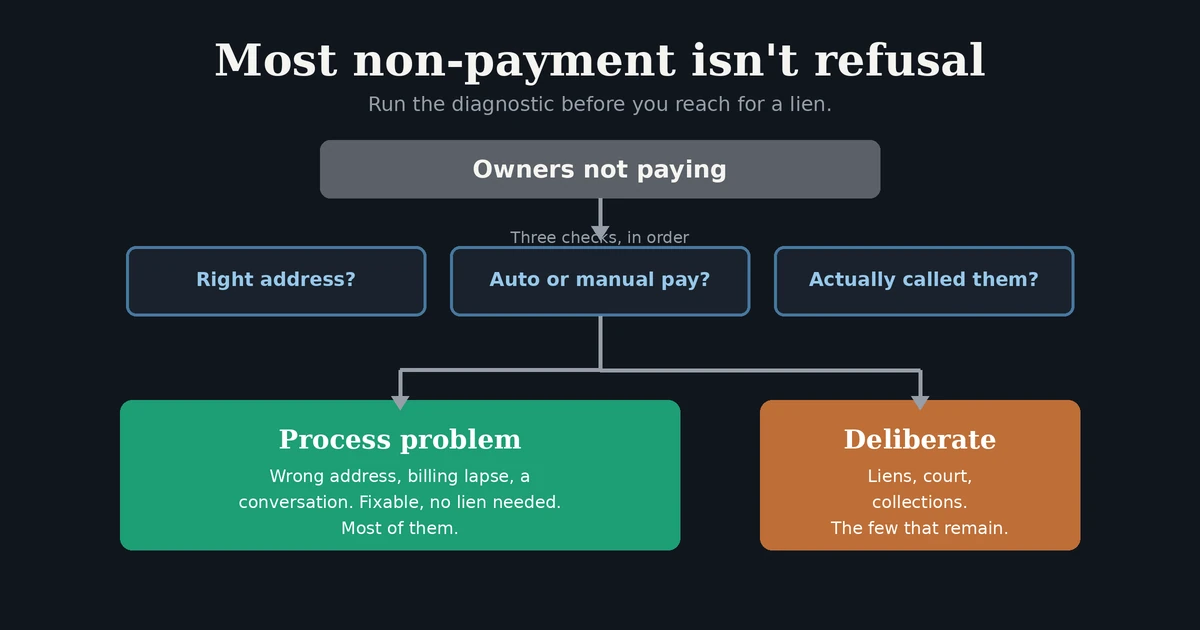
There's a specific check I told him to run first. Look at the small group of owners who ARE paying. Are they on automated payment? Now look at the ones who aren't paying. Are they on manual payment?
Because if the answer to both is yes, you have a mechanical problem. Not a moral one.
Auto-pay owners pay because the system pays for them. They don't think about it. Manual payers pay only when they remember to mail a check or log in every month. They have to think about it every time. If your association quietly switched billing methods last year, or if the manual-pay process got harder, the owners who couldn't keep up with that change become "non-payers" on the spreadsheet. Even when they would have happily paid if asked correctly.
The absentee landlord problem makes all of this worse. If your HOA sends paperwork to the unit address instead of the registered owner's address, an absentee landlord literally never sees it. Their mailbox is at the townhome. They live somewhere else. They might be perfectly willing to pay if they got the invoice. Meanwhile, the board is filing them as deliberate non-payers.
What you might find when you actually call
Once you do reach the non-paying owners, you might hear things the board never bothered to ask. Common reasons I've seen for non-payment: the owner doesn't think the service is being delivered, there's an unrelated dispute with the board, personal circumstances like job loss or a death in the family, or they simply never receive the invoice.
Each of these has a different fix. The first three are conversations. The fourth is a process problem the board needs to address. None of them require a lien. Not one. And a lien wouldn't solve any of them anyway.
When it's actually deliberate non-payment
OK. You've checked the mechanics. Fixed the address problem. Called everyone who'll pick up. And you're still left with owners who can pay and just won't. Now what?
Now Illinois law gives the board real tools. Under the Illinois Common Interest Community Association Act (CICAA, the statute that governs most non-condo HOAs in Illinois), the board can file a lien on a delinquent unit the moment assessments go past due. The lien doesn't have to wait for a sale.
Once filed, the association can take the delinquent owner to small claims or circuit court. Get a judgment. Pursue collection through wage garnishment or bank levies in some cases. Boards can also retain collections agencies. Yes, it gets uncomfortable. But debt collectors are masters at their craft. When board notices have produced six months of silence, professional collections may be exactly the right move.
What the board is actually required to do
Here's something worth knowing if you're one of the paying owners watching the board do nothing. Board members owe a fiduciary duty to act in the association's interest. That includes yours. Sitting on widespread delinquency without working through the diagnostic above isn't just bad management. It can be a breach of that duty.
Your governing documents almost certainly spell out a collection procedure. When notices go out. How lien filings work. What triggers court action. The board is required to follow it. If they aren't, you have grounds to challenge their conduct. That can include formal complaints, and in serious cases, action against the board itself.
You also have a statutory right under CICAA to inspect the association's books and request records. If you don't know how many units are delinquent and what collection steps have been taken, ask in writing. The board has to let you see.
What you can do as a paying owner this week
You don't need to wait for the board to figure this out. You don't need a lawyer to start. Three concrete moves, in order. Diagnostic first. Legal escalation last.
- Pull the payment data. Get a list of who's paying and who isn't, and how they're paying (auto vs manual). If the pattern is "auto-pay people pay, manual-pay people don't," you've found a mechanical problem that doesn't need legal escalation.
- Verify the address on file for every owner, especially the absentee landlords. If the HOA is sending invoices to the property instead of the registered owner, fix that. Then watch what happens before doing anything else.
- Write a records request letter to the board. Date it, sign it, send it to the registered association address. Ask for the delinquency list, the address on file for each owner, and a written summary of collection steps taken so far. This starts a paper trail and forces the board to give you the data.
How to
Request the delinquency data from your board in writing
Before anyone files a lien, get the facts the board has and won't volunteer. This written request starts a paper trail and forces the board to hand over the numbers. Copy it, fill in the brackets, and send it to the registered association address.
Subject: Records request - assessment delinquency - [name], [unit]

To the Board of Directors:

I am an owner at [address] and a member in good standing. Under the Common Interest Community Association Act (765 ILCS 160), I request to inspect and copy:
- The current delinquency list (units past due and amounts owed)
- The address on file for each owner
- A written summary of the collection steps taken to date, and the billing method (auto or manual) for each unit

Please tell me when I can inspect these or receive copies. Sent [date].
[Name] / [phone, email]
The auto-versus-manual and address data is what tells you whether this is deliberate non-payment or a broken process, and the board has to produce it once you ask in writing.
That letter is step one.
You can send the above letter, or we can handle the whole case ourselves, from start to finish.
Get my free assessmentNo payment now. The $349 only starts your case if you act.
A note on cutting off shared services
Some owners ask whether the association can just stop letting non-payers use the dumpsters, gym, or pool. Short answer: it's complicated, and it's rarely the right first move. Service suspension has to follow whatever process your declaration specifies. Done wrong, it creates more legal exposure for the board than it relieves. Liens, demand letters, and court action are cleaner if it really comes to that.
FAQ
Should we just file a lien on every non-paying owner right away?
No. Before any legal action, run the diagnostic. Check whether the non-payers are mostly on manual payment while the payers are on auto. Check whether absentee landlords are getting invoices at the wrong address. Most of what looks like refusal is actually a process problem in disguise. Fix the process first.
How fast can the association file a lien in Illinois if it comes to that?
Once assessments are past due according to your governing documents (usually 30 to 60 days), the association can move to file a lien. There's no requirement to wait for a sale. The specific notice steps and procedural requirements come from your declaration and the relevant sections of CICAA, 765 ILCS 160.
What if the non-paying owners are absentee landlords?
This is one of the most common versions of the problem. The fix is usually administrative, not legal. Confirm the registered owner's address (not the unit address) and send all correspondence there. Many "deliberate non-payers" become regular payers the moment they actually receive the invoice.
Can the HOA just shut off our neighbors' garbage collection?
Not without following the process in your declaration. Service suspension is allowed in some cases, but the board can't just padlock the dumpster. Done wrong, it creates legal exposure for the association, usually more than it solves. Liens and court collection are cleaner.
What if a board member is one of the non-payers?
Serious conflict of interest. A board member who's delinquent on assessments can't vote on enforcement actions against other delinquent owners. Most bylaws also bar delinquent members from board service. Check yours, and if it applies, raise it at the next meeting.
How do I request the delinquency data from your board in writing?
Before anyone files a lien, get the facts the board has and won't volunteer. This written request starts a paper trail and forces the board to hand over the numbers. Copy it, fill in the brackets, and send it to the registered association address.